Wednesday, August 30, 2006


NY Times is Wrong on Clinton Foundation's Budget

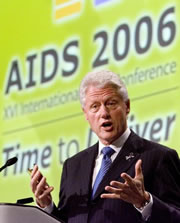
Yesterday's glowing front-page profile in the New York Times on former president Bill Clinton's efforts fighting HIV/AIDS around the globe made the following claim:

The Clinton foundation’s budget last year was $30 million, raised from private donors. Mr. Clinton, who oversees its operations full time, has plunged into many causes, from childhood obesity to tsunami relief to global warming, but he has made his most substantive contribution on AIDS.


I don't know where the Times got that $30 million figure from, because after looking at the latest IRS 990 filings for Clinton's two charities, it appears as though the paper reported an incorrect amount.

The William J. Clinton Presidential Foundation, based in Little Rock, Arkansas, in its most recent IRS 990 report, shows the foundation had revenue of $57.7 million. A little bit less than double of what the Times claimed was the foundation's budget last year.

His other charity, the Clinton Foundation HIV/AIDS Initiative, which is headquartered in Quincy, Massachusetts, had a much smaller budget, according to its only IRS 990 filing, and that amount was $5.9 million. Not exactly pocket change, but also not anywhere near the $30 million figure reported by the Times.

So far, the Times has not printed a correction about the wrongly reported figure for Clinton's foundation.

Tuesday, August 29, 2006


POZ: Fear Factor, HIV Vaccine Ads & People w/AIDS

My latest column for POZ magazine is about the use of fear by the San Francisco health department and the National Institutes of Health to recruit volunteers for HIV vaccine trials, and also how fear is occasionally a key factor in HIV prevention messages.

Excerpts from my column, appearing in the August issue of POZ:

In those early days, we all grappled with spooky unknowns. What, precisely, caused the dying—and how could we stop it, treat it, live with it, get the care and respect we deserved? In such a climate, fear of the disease and dying was probably one of the best options to spur behavioral changes that could save our and others’ lives.

Now, as AIDS turns 25, so much has improved for those fortunate enough to have survived and have accessed treatment. Why, then, is fear—demeaning, demonizing, repulsive fear—still being used to hype HIV prevention?

Every night, as I walk home from dealing with doctors, diagnostic tests or running to the pharmacy to perfect my ever-changing AIDS cocktail, I must pass an enormous billboard selling fear in San Francisco. [...]

A supposed friend of people with HIV, the Stop AIDS Project, recently launched a prevention campaign with an alarmist tagline so creepy it seems ripped from a ’50s pod-people double feature:

“Some of the guys you’ll cruise tonight have an STD.”

Attention, good people of San Francisco! Run for them thar hills and hope those guys don’t follow you, swim through the sewers up into your shower and nail ya.

Then there’s another billboard, from SFisReady.org. “Ready for the day when we can date without fear of infection?” it asks in large black letters.

This one’s a recruiting tool for the HIV Vaccine Trials Network. I support the trials and hope they produce a vaccine, but I absolutely loathe how the ad tries to make us feel bad—that all potential sex partners might think twice about dating me. That all we homosexuals—“the gays,” as we are often lumped—are diseased and should be handled with tongs. [...]


What I didn't know as I wrote the column is that the CAB, community advisory board, for the San Francisco branch of the vaccine trials had heard from other gay men and people with AIDS, back in the spring, complaining about the campaigns and how they contribute to stigmatizing people living with HIV or AIDS.

As hard as it to believe, the CAB does not post its agendas or minutes on its web site, even though federal statutes require the board to share this public information, without a member of the public having to file a FOIA request. Someone should inform the CAB that the community has a vested interest in the work of HIV vaccine researchers, and that it has a sacred duty to keep the community at-large up-to-date on the trials and work of the CAB.

That being said, I have sent a FOIA request to the health department and the CAB, asking for their agendas and minutes over the past two years and have left messages for the health officials, requesting them to expand the CAB's site to regularly post information about their meetings and the topics discussed.

I've also managed to obtain the minutes, which appear in full below, from the CAB's meeting in April, when the group dealt with community concerns about the language in the recruitment ads.

From the minutes:

[Jen Sarche, director of community education] noted that we have received several emails regarding our “Ready for Love,” and “Ready to Date without Fear of Infection” ads which have appeared in the past two and a half months in Muni Stations and bus shelters. The emails expressed concern that the ads unintentionally stigmatized HIV positive people, or that they encouraged unsafe sex. A community member attending the meeting addressed his concerns to the CAB as an HIV positive individual, saying the ads were causing a “stir” in the community and felt the ads implied that people who were HIV positive could not be dated or loved without fear.


So how did the CAB respond to these community concerns?:

The CAB felt strongly otherwise noting the need to have messages directed at HIV negative individuals. Both HIV negative and HIV positive members of the CAB stated that fear can be a palpable and at times useful emotion. CAB members also pointed out the ads speak about fear of HIV infection which is significantly different than fear of HIV positive individuals.


While the CAB members, regardless of HIV status, believe fear is a proper tool in the fight against AIDS, and for them such an attitude may be appropriate, I don't think it's okay for the CAB to dismiss the concerns of people who took the time to write to the CAB and attend the meeting to express reservations. In my opinion, the CAB should listen to the community members who are troubled by the fear message and develop recruitment messages based on other factors.

More excerpts from the minutes:

The ads have sparked an increase in discussion about HIV vaccines as well as an increase in calls from potential participants. After a good and spirited discussion it was agreed that the current ads will remain in place. [...]

The CAB then reviewed a new ad that will be forthcoming in June. The ad ties into Pride for June, and talks about taking pride in joining an HIV vaccine study. The response to the new ad was less than enthusiastic. [...]


Sounds to me the CAB chose to ignore individuals from the community not happy with the CAB's work. So much for the CAB representing the full spectrum of opinions from the community!

Interesting that these minutes show some community members were less than enthusiastic about the use of fear, and took the time to write or show up at the meeting, while at the same time, without any sourcing, the minutes also illustrate the response to the Pride message was supposedly less than enthusiastic also. Odd that the minutes don't reveal who exactly lacked enthusiasm for the Pride campaign in June.

Did the CAB receive emails from the community showing no enthusiasm for the Pride ads, or was it just CAB members who weren't enthusiastic?

It is frequently said that we're all in the battle against AIDS together, whether we're poz or negative, a researcher or person living with AIDS, someone who struggles to live on disability benefits or an executive at a service organization making more than $200,000 annually.

On a basic level, I agree that everyone is affected by HIV and should be supportive of efforts to find a cure and an effective and affordable vaccine, and one way to keep us united to control and end AIDS is by insisting the HIV vaccine CAB in San Francisco listen to community members angry over the use of fear to sell the trials, and that the CAB publicize its monthly meetings and post its agendas and minutes on the web.

Here are the full minutes from the April CAB meeting:

HIV Research Section
San Francisco Department of Public Health
Community Advisory Board Minutes
April 18, 2006

Present: Alan Bettis, Brad Vanderbilt, Brent Sugimoto, Darnell Durio, Jamie Nesbitt, Jeff Gustavson, Karl Knapper, Michael Tyree, Naomi Akers, Stephan Oxendine, Steve Muchnick, Marina Rifkin, David Diaz, Albert Liu, Gavin Morrow-Hall, Jen Sarche, Jonathan Fuchs, Susan Buchbinder, and Parker Nolen (guest)

Announcements

- Steve Muchnick wrote a letter of support for Sonya’s R01 grant, and worked with Naomi to write one for the IDEA grant, and copies are available to the CAB.

- UCSF is looking for recruiters with experience working in communities of color for a gay couples study – contact Brad Vanderbilt if you know someone who is interested.

- We enrolled the180th participant in the ACE Study (HPTN 039) and enrollment will close internationally at the end of May. Thanks for all who helped make this day happen.

- The Volunteer Appreciation event is scheduled for June 8th – put it in your calendar. Invitations will go out in May.

- A health provider’s community forum is scheduled for May 3rd addressing emerging issues in HIV prevention, including PrEP, Serosorting, and Superinfection. We are hosting the forum with the San Francisco AIDS Foundation.

- Susan will conduct a HIV vaccine chat on gay.com May 17th, the day before HIV Vaccine Awareness Day – watch for login information.

Names Based HIV Reporting

California Governor Schwarzenegger signed SB 699 into law on April 17th, authorizing the use of names-based HIV incidence reporting in California. The change means that HIV testing sites will now be required to report new HIV cases by name to the state for reporting to the CDC. The CDC will use these data to determine CARE and Prevention funding for the state. This is a significant change from the previous non-name reporting which utilized a code-based system. Some members of the prevention community are concerned that the change will discourage people from seeking out HIV testing.

Participants in our prevention research studies are exempt from the names-based reporting requirement because of the protections in place for confidentiality.

The CAB recommended that we increase our community education efforts around fears around vaccine-induced positive tests and whether they are reportable, and made comments for clarification of the language around these issues in our consent forms. Questions were also raised about how the new law impacts people who were previously tested in confidential testing sites, and whether the state will go back to decode all the past HIV cases identified in California. Jonathan will clarify this part of the law and we will report back to the CAB about it at a future meeting.

Community Input into our recruitment ads

Jen noted that we have received several emails regarding our “Ready for Love,” and “Ready to Date without Fear of Infection” ads which have appeared in the past two and a half months in Muni Stations and bus shelters. The emails expressed concern that the ads unintentionally stigmatized HIV positive people, or that they encouraged unsafe sex. A community member attending the meeting addressed his concerns to the CAB as an HIV positive individual, saying the ads were causing a “stir” in the community and felt the ads implied that people who were HIV positive could not be dated or loved without fear.

The CAB felt strongly otherwise noting the need to have messages directed at HIV negative individuals. Both HIV negative and HIV positive members of the CAB stated that fear can be a palpable and at times useful emotion. CAB members also pointed out the ads speak about fear of HIV infection which is significantly different than fear of HIV positive individuals.

The ads have sparked an increase in discussion about HIV vaccines as well as an increase in calls from potential participants. After a good and spirited discussion it was agreed that the current ads will remain in place. Further discussion followed about the process for CAB approval of our ad materials. Because of time pressures, it is not always possible to wait for CAB meetings to get input into the ads. A small media review working group will be created which will be asked to look at advertisements on-line and get feedback back in within a couple of days.

The CAB then reviewed a new ad that will be forthcoming in June. The ad ties into Pride for June, and talks about taking pride in joining an HIV vaccine study. The response to the new ad was less than enthusiastic. Jen will work with our designer and inform the CAB of the finalized product.

Press and Communications around Project T

In the past month there has been a lot of press about pre-exposure prophylaxis, both about whether it is currently in use in the community, and whether TDF or Truvada were the better agent for it. An article went out over the Associated Press wire and was picked up by hundreds of news organizations. The content of this story was fine, but slightly confused, especially with regard to the tenofovir vs. Truvada information. More concerning were the headlines that were printed with the article, such as, “New pill protects against HIV.” Susan and Al also gave several interviews for original stories as well, including the San Jose Mercury News, the Wall Street Journal and CNN.

As a result, the PrEP Communications Working Group that has been previously discussed will be convened by the CDC to create some clearer messages for broad distribution. The Working Group will include representatives from each U.S. PrEP site, Brad and Steve O. will represent our CAB. We will convene a Project T working group meeting, including interested members from the community, to give Brad and Steve an agenda to present to that group.

Al will be speaking at a forum, hosted by CHAMP and AVAC, on PrEP in NYC next week.
Results from the PrEP survey that Al is conducting will be available by summer although to date no significant use of PrEP has been noted.

Explore and New Choices Data

New data from the Explore study has been released showing the significant predictors of HIV infection included the following:

- Having unprotected sex as a “bottom” with someone who is HIV +, HIV status unknown or a person believed to be HIV –

- Having unprotected sex as a “top” with persons known to be HIV infected

- Having had four or more anal sex partners in the previous six months

- Heavy (four or more drinks per day) alcohol use or having six or more drinks at one time

- The use of alcohol and drugs before or during sex

- Use of amphetamines

- Depression

- Gonorrhea

This new data seems in line with previous studies conducted by the Research Section that indicated that unprotected sex with unknown or persons perceived to be HIV negative, having multiple sex partners and use of alcohol and drugs were predictors of HIV infection.

Results from the New Choices study, a cross-sectional study looking for emerging risk factors for HIV infection, found that use of both crystal meth and Viagra (not necessarily together) were associated with unprotected anal sex with an HIV discordant or serostatus unknown partner.

The CAB stated that information was useful but did not discover new territory nor address the root causes of this kind of risk. The CAB wondered what the new data means in terms of future programming and policy directed at gay men. The CAB specifically wanted to know why will two percent of gay men still become infected this year and how do we create a healthier gay men’s community.

No one had clear answers to the questions but it was noted that the San Francisco Gay Men’s Community Initiative is addressing these concerns and should be invited to attend a future CAB meeting.

Wednesday, August 23, 2006


SF Chron: Iran's Stonings; 138 British MPs Condemn Killing Gays, Minors

I have two items to share with you regarding Iran and executions. The first comes from the Matier & Ross political gossip column that ran in the August 20 edition of the San Francisco Chronicle. Though it is short and bland about the emotional issue of stoning women, I'm satisfied the paper gave some space to Iran's barbaric ways of killing people, and the State Department preventing Iranians who studied in the US from visiting California for a reunion.

The second piece of news is from our dear pals in OutRage!UK. They report that more than one hundred members of parliament recently deplored Iran's hanging of gays and minor

The Chronicle said:

Last week, the ever-progressive Supervisor Ross Mirkarimi, who happens to be Iranian American, won unanimous board approval of two board resolutions near and dear to his heart.

The first resolution condemned the State Department for turning back a group of Iranian university alumni -- who recently landed at SFO for a reunion in Santa Clara -- because they allegedly posed a security risk.

The second resolution asked for the State Department's help to condemn the Islamic Republic of Iran for the reported stoning deaths of two women accused of adultery.

As for how Mirkarimi explains condemning the State Department in one breath, and then asking for their help in condemning the Iranian government in the next?

Simple, said Mirkarimi, "I consider myself a pragmatic."


And here is the release from OutRage!UK:

138 British MPs condemn Iran's execution of gays and minors;
Call for Iran to observe the international human rights conventions it has signed

London – 23 August 2006
Further information:

Brett Lock – OutRage! 0770 843 5917

Chris Bryant MP – 020 7219 8315 or 01443 687 697

British MPs from all parties have signed an Early Day Motion in the House of Commons condemning Iran's execution of gay people and children (full text below).

The motion was tabled by out gay Labour MP, Chris Bryant, who represents the south Wales working class constituency of the Rhondda.

"So far, 138 MPs have signed the EDM," reports Brett Lock of the gay human rights group OutRage!, which helped brief the MP on human rights abuses in Iran.

"Many more would have signed had it not been for the summer period when lots of them go away. We are delighted that so many MPs are concerned about the persecution of gay people and of women who don't conform to Tehran's hardline interpretation of Islam."

Mr Lock also praised Chris Bryant for raising Iranian human rights abuses during the House of Common’s European Union Affairs debate in June (copy below):

"Chris made a moving, informative contribution to the debate, exposing Iran's increasing use of the death penalty for a wide range of crimes, including violations of Islamic morality," noted Mr Lock. "When it comes to the barbaric hangings in Iran, Chris is the conscience of the Commons."

EDM 2616
IRANIAN EXECUTIONS OF MINORS
19.07.2006

Bryant, Chris – Labour MP for Rhondda:

That this House commemorates the anniversary of the public hanging on 19th July 2005 of two gay teenage boys, Mahmoud Asgari and Ayaz Marhoni, in Mashad in Iran; notes that at the time of their alleged crimes the two boys were at most 17 years and possibly younger; further commemorates the hanging in Nekra in northern Iran on 15th August 2004 of a 16 year old girl, Ateqeh Sahaleh, on charges of un-Islamic behaviour; condemns these and all other Iranian executions of under-age minors, which are in direct contravention of the International Convention on the Rights of the Child, to which Iran is a signatory; notes that as many as 4,000 Iranians have been executed for their homosexuality since the Islamic Revolution in 1979; and
calls on Iran to stop its campaign of torture, harassment and ill-treatment against gays and to end all executions of minors.

Signatures (138)

Bryant, Chris
Herbert, Nick
Joyce, Eric
Gove, Michael
Eagle, Angela
Llwyd, Elfyn
Prentice, Gordon
Purchase, Ken
Reid, Alan
Ruddock, Joan
Simpson, Alan
Spellar, John
Harris, Evan
Heath, David
Hood, Jimmy
Hoyle, Lindsay
Johnson, Boris
Jones, Kevan
Keen, Alan
Linton, Martin
Marris, Rob
Maude, Francis
McDonagh, Siobhain
McDonnell, John
McKechin, Ann
Moore, Michael
Morley, Elliot
Mountford, Kali
Mudie, George
Mullin, Chris
Breed, Colin
Buck, Karen
Campbell, Ronnie
Challen, Colin
Clapham, Michael
Cohen, Harry
Cryer, Ann
Davies, David TC
Dobson, Frank
Doran, Frank
Efford, Clive
Fisher, Mark
Flynn, Paul
Francis, Hywel
George, Andrew
Goodwill, Robert
Abbott, Diane
Hamilton, David
Baker, Norman
Bercow, John
Betts, Clive
Stewart, Ian
Strang, Gavin
Stringer, Graham
Tami, Mark
Taylor, Dari
Taylor, David
Teather, Sarah
Thurso, John
Wright, Iain
Younger-Ross, Richard
Hillier, Meg
Brown, Lyn
Butler, Dawn
Clark, Katy
Creagh, Mary
Flello, Robert
Goodman, Helen
Griffith, Nia
Hands, Greg
Jackson, Stewart
James, Sian C
Johnson, Diana R
Keeley, Barbara
Horwood, Martin
Khan, Sadiq
McCarthy-Fry, Sarah
Thornberry, Emily
Newmark, Brooks
Penning, Mike
Pritchard, Mark
Waltho, Lynda
Reed, Jamie
Shapps, Grant
Willott, Jenny
Pope, Greg
Rosindell, Andrew
Spink, Bob
Jones, Lynne
MacKay, Andrew
Meale, Alan
Burgon, Colin
Cable, Vincent
Caton, Martin
Conway, Derek
Corbyn, Jeremy
Dean, Janet
Durkan, Mark
Garnier, Edward
Hancock, Mike
Bottomley, Peter
Weir, Mike
Hemming, John
Austin, Ian
Moon, Madeleine
Williams, Stephen
Price, Adam
Pugh, John
Russell, Bob
Sheridan, Jim
Hermon, Sylvia
Hopkins, Kelvin
Iddon, Brian
Lepper, David
Loughton, Tim
McCafferty, Chris
Brake, Tom
Burden, Richard
Cummings, John
Dismore, Andrew
Drew, David
Bayley, Hugh
Vaz, Keith
Vis, Rudi
Wareing, Robert N
Williams, Betty
Anderson, David
Leech, John
McGovern, Jim
Holmes, Paul
Illsley, Eric
Lewis, Julian
Moffatt, Laura
Gerrard, Neil
Williams, Hywel
Willis, Phil
Wyatt, Derek
Swinson, Jo


Chris Bryant MP, speaking in the House of Commons debate on European
Union Affairs on 14 June 2006:

Hansard – official transcript of the parliamentary debate:

14 Jun 2006 : Column 864

Equally important, however, is the issue of human rights in Iran. Iran’s human rights record is grisly. It has been so for many years, but in many ways it has become worse in the past 18 months. Last week in the other place, Lord Triesman reported that the number of executions in Iran had increased dramatically compared to this time last year. We know that the use of the death penalty in Iran is on the
increase: Amnesty International reckons that there were at least 94 instances of its use last year in Iran, and the International Federation of Human Rights estimates a much higher number of cases—between 300 and 400.

I know that not all hon. Members believe that the death penalty is wrong. I believe that it is wrong in all instances, just as torture is wrong, but it is particularly wrong when it is imposed on minors—those aged under 18. Last year, at least nine people aged under 18 were executed in Iran. In 2004, a 16-year-old girl was hanged for fornication and a 14-year-old boy was whipped to death for eating during Ramadan. That is not a situation that people either in this country or across the European Union can countenance any longer.

Furthermore, the death penalty is regularly used in Iran for lavaat, or homosexuality. On 19 July 2005, Ayaz Marhuuni and Mahmoud Askari were executed in Mashhad. They were both 17, although the authorities tried to say that they were 19, and at the time of the alleged crimes, they were probably 15 or 16. Almost certainly, the charges presented against them, which changed from day to day, were trumped up. Not only were they hanged, but it was not a British-style hanging; instead, as is often the case when the death penalty is used for lavaat, they were
executed by a slow hanging method whereby a thin cord is placed to the side of the neck so that the neck does not break and the person struggles on the cord, often for several minutes, before being asphyxiated. It is a deliberately brutal and cruel death, which we should not countenance.

At least 11 people were executed for lavaat between December 2004 and November 2005. Many more have been sentenced and no more has been heard of them, but we can be fairly certain that in many cases the execution has happened, not in public as used to happen, but in private. In addition to that, there are many honour killings in parts of Iran. One expert on the Ahwaz region said that homosexuals

“are generally killed in Ahwaz, by the security forces or by their male kin, in one of three ways: strangulation, throat-slitting or decapitation. If the homosexual youths are killed by the security forces, their corpses—frequently decapitated but accompanied by their heads—are left in the street. Their families therefore have a certain tragic incentive to kill them more humanely”


Madam Deputy Speaker: Order. In the limited time left, the Hon. Gentleman should relate his remarks to the European Union.

Chris Bryant: I am grateful to you, Madam Deputy Speaker. I was about to say that what the EU has tried to do, albeit perhaps not frequently enough, is raise such human rights issues in its discussions with the Iranian authorities. I believe that this week provides a real opportunity for the EU to make progress and, in particular, to make sure that no EU country repatriates anyone from Iran who seeks asylum by virtue of their homosexuality. Some people have been repatriated to Iran by other European countries and have subsequently been executed. There are, of
course, countries in Europe that have a mixed record on those human rights issues, but I believe that the EU has a unique opportunity to move forward with a robust record on human rights.

Ends

Monday, August 21, 2006


White House: Security Net's Holes; Cheney's "Groundhog Day"

Consider this hypothetical question: What if you're a terrorist intent on finding vulnerable spots in America's security nets, how would you go about finding those vulnerabilities?

One way would be to read the New York Times, which President George Bush and his administration maintain feeds information to evil-doers when the paper reports on programs like the National Security Agency's warrantless spying.

You might get a terrorist buddy a job at the Justice Department and have him access secret documents on the lack of information sharing between immigration officials and law enforcement agents.

Another way would be filing Freedom of Information Act requests with the Department of Homeland Security for records on the agency's screening efforts targeting air cargo shipments and airline passengers, and the effectiveness of the current screening processes, almost five years after 9/11.

But why go through any of those cumbersome steps when all you need do to learn about gaps in our security is visit the White House's "Expect More" web page. There, you'll learn exactly where the gaps are, with just a few mouse clicks.

Click here to learn about the
"Automation Modernization Program [which eventually] will provide Immigration and Customs Enforcement with the necessary technology to communicate and share information within the agency and with its other law enforcement and immigration partners [...] The program has weak program and management structure and must dramatically improve its ability to manage its resources."

To be honest, I thought this program of integrated data sharing for ICE was already in place, but I was wrong and what is in place right now is so lame the White House wants dramatic improvements.

What's the status of the Transportation Security Administration's protection of cargo and passengers? We're okay on these matters, right? Guess again.

"TSA should improve improve [sic] methods to evaluate risks and vunerability [sic] in the air transportation system as it relates to air cargo. The program has recently developed interim long-term and annual measures to measure program effectiveness. However, due to data limitations, the program is unable to measure the risk reduced as a result of implementing program objectives. Work remains to close security loopholes, including improving screening efforts and refining procedures to approve indirect air carriers. The program has developed a strategic plan and is deploying a new security screening system, both of which are steps in the right direction."

Click here for the source of this sad news.

Don't fear, this is what the TSA is doing to implement more security in the air:

"Improving methods used to evaluate risks and vulnerability in the air transportation system through the 'Freight Assessment System.' TSA willl [sic] fully deploy this system in 2008."

Hmmm, more than a year away before that system is up and running. Doesn't exactly instill confidence in me. How about you?

Surely the TSA program screening our luggage must be doing a good job. Right?

"The Baggage Screening Technology program provides the technology necessary to prevent the entry of dangerous weapons, particularly explosives, on aircraft through inspection of checked baggage."

That's sounds very reassuring, until one reads about the problems with the technology and when the TSA expects better screening to be operational:

"The baggage screening technology architecture is sound, although questions exist regarding the efficiency of its current deployment within airports. The program now has strong performance measures, but targets are under development. The program has not yet undertaken an evaluation of sufficient scope and quality [...]

"[The TSA is] procuring and deploying approximately 125 Next Generation explosive detection machines by 2007."

Follow this link
for the source material.

Notice they say those new devices should be ready by 2007, but the issue of whether they'll be operational is not addressed. What's the rush anyway, all these years after the September 11 tragedy on our soil? It must be a priority for Bush administration officials.

Maybe the TSA's program for screening passengers and carry-on bags and preventing the introduction of guns and explosives on planes is meetings some stated goals? Nope, this technology program falls into the "Results Not Demonstrated" category:

"The assessment found that the Passenger Screening Technology program was unable to demonstrate outcome-based performance results. The program recently developed annual performance measures, but targets are under development. The program has not yet undertaken an evaluation of sufficient scope and quality. Work remains to develop long-term measures. TSA is in the process of implementing better management information systems so that performance oversight of technology contractors is improved."


When newspapers report on these failures in our security nets, Bush and his officials at the Department of Homeland Security accuse the publications of providing damaging information to the country's enemies. But when the same information appears on the White House site, with no apparent rush to close these security holes, it's not aiding and abetting our foes. How long will the White House post this data before the administration gets serious about protecting us?

Oh, one more small thing. Will someone please ask the White House to use spell-check and grammar-check for the Expect More site?


Cheney's "Groundhog Day"


Vice President Dick Cheney traveled to Arizona last week in his official capacity as chief fundraiser and scaremongerer, and just for sating my curiosity, I took one troubling phrase from his speech and Googled it. Something about the phrase sounded terribly familiar.

Sure enough, Dick, Dick, Dick! has been using the exact quote, and same boring deadly talking points since at least February of this year:

Vice President's Remarks at the 46th Annual American Legion Conference
Tuesday, February 28, 2006


"We can expect further acts of violence and destruction by the enemies of freedom."


Updated: 19 Apr 2006
Cheney addresses U.S. soldiers at Fort Riley, Kansas


"We can expect further acts of violence and destruction by the enemies of freedom."


June 23, 2006
REMARKS BY THE VICE PRESIDENT
AT A LUNCHEON FOR CONGRESSIONAL CANDIDATE DAVE MCSWEENEY
Hilton Chicago


"We can expect further acts of violence and destruction by the enemies of
freedom."


June 27, 2006
Remarks by the Vice President at a Luncheon for Congressional Candidate Adrian Smith
Midtown Holiday Inn Convention Center Grand Island
Grand Island, Nebraska


"We can expect further acts of violence and destruction by the enemies of freedom."


June 30, 2006
Vice President's Remarks at a Luncheon for Congressman Scott Garrett
Waldorf Astoria New York, New York


"We can expect further acts of violence and destruction by the enemies of freedom."


August 16, 2006
Dick Cheney Visits Idaho
By Jolyn Thomas


"We can expect further acts of violence and destruction by the enemies of freedom."


August 15, 2006
Vice President's Remarks at a Luncheon for Arizona Victory 2006
Arizona Biltmore Resort and Spa
Phoenix, Arizona


"We can expect further acts of violence and destruction by the enemies of freedom."


Mr. Vice President, in reminding Americans that we can expect the enemies of freedom to stay the course in waging attacks against us and each other in Iraq, do you honestly believe you are instilling confidence in your plan of action for the war over there?

Repeating the same deadly expectation this past year for hand-picked audiences is not leadership and you should start to level with us about precisely when we can pull our troops out of harm's way. Bring the troops home and you won't have to make the same speech anymore.

Sunday, August 20, 2006


CDC's Gay HIV Chief MIA at Toronto; Bush's AIDS Silence

The name Dr. Kevin Fenton should ring a bell for you. He's the openly gay black man who heads the CDC's division of HIV and STD prevention, but to judge from the dearth of news articles, only one, and blog mentions, zero citations and I used two blog search engines, Google's and Technorati's, he may not have used the just-concluded 16th international AIDS conference in Toronto to his full advantage.

I want whoever is running CDC's HIV prevention programs to really put himself or herself out there at the biennial meetings, where so many are gathered to learn from and teach the CDC. One way to reach not just the participants who went to Toronto, but people with AIDS and activists who, like me, didn't attend but nonetheless monitored what was happening and blogged about it all, is through the mainstream media and blogosphere. It's not rocket science figuring out ongoing communication from CDC to AIDS activists and professtionals.

And it's not as though Dr. Fenton himself would have to personally send out a release or establish a blog to reach and engage an audience that wants leadership from him. He has the enormous CDC press operations to get press and blog attention, and he should have done better in this regard last week.

Reading news accounts and blog postings about the minimal focus on gay prevention needs over all and particularly for black gay men at Toronto, I wondered why he didn't use his powerful position to guarantee gay black issues were on everyone's agenda? Does he not know how to use his federally-funded bully pulpit to reach under-served audiences at-risk of HIV infection?

And let's not overlook the fact Dr. Fenton was born in Jamaica, a country hard-hit by HIV and a rampant violent homophobia that has directly contributed not only to the murders of gay HIV prevention workers there, but also to the soaring rates of infections in the Caribbean nation. Would have been nice of him to have organized a panel or event on the matters facing gay men in Jamaica today in staying alive and not contracting HIV, or living with it if they are positive.

Okay, now that I've addressed some of the identity-politics aspects incumbent to Dr. Fenton and his performance on the world stage last week, I want to broaden the frame a bit. Putting aside those aspects, I'm still left with an overwhelming sense of a dangerous low-key approach on his part to raising any of the CDC's HIV prevention agenda and messages for everyone at Toronto, not just targeting gays and blacks.

We need the person directing CDC's prevention work to use traditional and new web media to reduce HIV rates, engage a wide spectrum of people and to do a better job of informing not just the AIDS community, but all of the American public about his efforts.

For whatever reason, the CDC's media office had a muted press strategy at Toronto, unlike previous conferences where CDC really milked the many media opportunities at any AIDS conference. If Google and the CDC's press office web page are any indication, the agency didn't put out a single release, make it known how to contact CDC officials or stage any news briefings.

At the same time, I wish to point out that Dr. Fenton's ultimate boss, President George Bush, was also quiet about AIDS last week, or at least the White House web site's AIDS page had nothing about the Toronto meeting and its stated goals, much of which involve the a big portion of the U.S. government. The Office of National AIDS Policy page was last updated in February.

Why have such an office in the White House advising the president, with no clear activities for seven months, and at minimum send a message from the Oval Office to the attendees at the conference, maybe even announce new funding streams to combat AIDS and assist those living with HIV?

I'm not suggesting that Bush tear himself away from battling terror and spreading democracy in the Middle East and make a video welcome for Toronto, or perhaps hold a cabinet meeting on AIDS while the conference is underway, but please, something, anything other than SILENCE on White House site and from the president and his top-level staff is necessary to ensure AIDS doesn't fade from the public's agenda.

Friday, August 18, 2006

SF Chronicle: U.S. Constitution Arrested!

Sure, this great "Bad Reporter" comic strip by Dean Asmussen is amusing, but given half a chance, you can be sure George W. Bush and his cronies would love to incarcerate the Constitution and throw away the key.


Click on the image to enlarge it. And keep reminding yourself, only two-and-a-half depressing years to go before Bush retires to his Crawford, Texas, ranch.
HRW's AIDS Blog and "Victims"

Conor Fortune
Communications Associate
Human Rights Watch
New York, NY

Dear Mr. Fortune,

Several days ago I blogged about HRW's AIDS blog and use of the term "victim" to describe people with AIDS.

I would like to know who I need to contact at HRW regarding the following questions:

1. Why does HRW use "victim" when writing about people living with HIV/AIDS on the group's blog?

2. Is HRW not aware that many, if not all, people with HIV and AIDS, consider the term "victim" offensive and adds to the stigma surrounding the disease and people with it?

3. Will HRW apologize for using the word "victim" on its AIDS blog?

4. Who at HRW is responsible for that blog?

5. Can HRW remove "victim" from the AIDS blog and replace it with people living with HIV/AIDS?

A prompt reply is requested and appreciated.

Best regards,
Michael Petrelis
Person Living with AIDS
San Francisco, CA
Ph: 415-621-6267

Sources:
HRW AIDS blog,
My blog post about HRW's use of "victim"

Wednesday, August 16, 2006


Saudi Officials Arrest Twenty Men at "Gay Wedding"

This troubling news came my way from two good friends, each on polar opposites of the political spectrum, who independent of the other sent me this article from the South African Press Association - Agence France-Presse wires, showing that for at least two of my buddies, when the issue is the treatment or abuse of gays in the Middle East and other parts of the globe, they want me to see the news and bring it attention.

An excerpt from the only story so far on this case:

Riyadh - Saudi authorities arrested 20 young men after raiding a suspected gay wedding in the southern town of Jizan, a newspaper reported on Wednesday.

The detainees, who were among some 400 men attending "the wedding party of two men" on Tuesday, had been "emulating women," the Al-Watan paper said.

In all, some 250 people were detained in the police raid on the party but the rest were later released [...]

Some guests were also seen chewing qat, an illegal narcotic widely used in neighbouring Yemen, on a hill above the square where the party was being held, Al-Watan said.

Homosexuality is illegal in conservative Saudi Arabia, which metes out strict punishments based on sharia, or Islamic law.


The GayMiddleEastReport.com site has a trove of background information and stories about the violations of human rights protections for gays in Saudi Arabia. Click here to start reading the collected stories.

You know me, I read something like the article about the latest arrests and I want to throw together a press conference at a Saudi consulate, but there isn't one in San Francisco. If I lived in Washington or New York, I'd be organizing an action at the Saudi embassy or mission the United Nations.

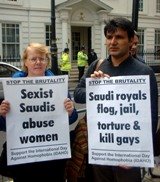
(Photo credit: Brett Lock, OutRage!UK. London gays protesting at the Saudi embassy in May.)

Human Rights Watch Labels People With AIDS "Victims"

Ever since the HIV/AIDS epidemic began, people living with the disease have vigorously fought being labeled "victims" and generally prefer terms such as PWA, person with AIDS, or PLWHA, people living with HIV/AIDS.

One group that didn't get the memo about this is the Human Rights Watch. Today on HRW's blog from the Toronto AIDS conference, the group asks bloggers to show solidarity "with the victims" of the disease.

Needless to say, I was shocked to see the normally hyper politically correct HRW refer to people with AIDS as victims and I've contacted the leaders at HRW to request that they remove the reference to victims from their blog. While it would be nice if HRW also apologized to persons with HIV/AIDS for calling us victims, right now, I'll be happy if they just delete the word victims.

From HRW's AIDS blog:

If you are a blogger, you can use your bully pulpit to stand with the victims and activists to end human rights abuses for those with HIV/AIDS, strengthen the political will necessary to win the fight against AIDS, and expand access to HIV prevention information, condoms, clean needles, methadone and anti-retroviral drugs.

Monday, August 14, 2006


Toronto AIDS Confab: SF Rates Plateau Due to Serosorting

An important abstract from San Francisco was presented today at the Toronto AIDS conference showing new HIV infections reached a plateau years ago, after peaking seven years back in 1999, and that the reason for this good news is probably due to serosorting practices developed by sexually active gay men, both HIV poz and negative. To me, it says much about the HIV prevention industry, which does not promote in any way serosorting as an effective means to stop HIV, that serosorting plays a crucial role in preventing and controlling new infections.

The full abstract:

HIV serosorting? Increases in sexually transmitted infections and risk behavior without concurrent increase in HIV incidence among men who have sex with men in San Francisco

Background: Sexually transmitted infections (STI) and unprotected anal intercourse (UAI) have been increasing among men who have sex with men (MSM) in San Francisco. However, HIV incidence has stabilized. We evaluated recent trends in sexual risk behavior, STI, and HIV incidence to assess whether increases in HIV serosorting (i.e., selective unprotected sex with partners of the same HIV serostatus) may contribute to preventing further expansion of the epidemic.

Methods: The study applies an ecological approach and follows the principles of Second Generation HIV Surveillance. Temporal trends in biological and behavioral measures were assessed using multiple pre-existing data sources: STI case reporting, prevention outreach programmatic data, and voluntary HIV counseling and testing data.

Results: Reported STI cases rose from 1998 through 2003. Rectal gonorrhea cases increased from 158 to 311 while early syphilis increased from 8 to 314. UAI increased overall from 1998 to 2004 (p<0.001) in community-based surveys; however, UAI with partners of unknown HIV serostatus decreased overall (p<0.001) among HIV-negative MSM, and among HIV-positive MSM declined from 30.7% in 2001 to a low of 21.0% in 2004 (p<0.001). UAI (any, receptive, insertive) with a known HIV-positive partner decreased overall from 1998 to 2004 (p<0.001) among MSM at HIV testing programs. HIV incidence using the serological testing algorithm for recent HIV seroconversion (STARHS) peaked in 1999 at anonymous testing sites (4.1%) and the STI clinic confidential testing program (4.8%), with rates leveling off through 2004.

Conclusions: HIV incidence among MSM appears to have stabilized at a plateau following several years of resurgence. Increases in the selection of sexual partners of concordant HIV serostatus may be contributing to the stabilization of the epidemic. However, current incidence rates of STI and HIV remain high. Moreover, a strategy of risk reduction by HIV serosorting can be severely limited by imperfect knowledge of one´s own and one´s partners´ serostatus.

Back in May, the Bay Area Reporter ran an excellent piece by Matthew Bajko about serosorting and how the city was about to get the nation's first media campaign about the practice.

From Bajko's article:

The San Francisco AIDS Foundation, however, is about to become the first AIDS agency in the country to discuss serosorting in a social marketing campaign. The agency plans to launch advertisements and a Web site this June that will not only discuss serosorting but other controversial methods like "negotiated safety" or seropositioning – where a negative man will only top or a positive man will only bottom during sex.


Well, two months later the AIDS foundation has not launched its serosorting campaign, but it may not matter much that this appears to be an empty promise from the foundation, because gay men are engaging in serosorting sexual practices that do much to halt new HIV infections, all without any help from HIV prevention groups or the Centers for Disease Control and Prevention.